📖 Table of Contents▼
Setu: How Ancient Swarm Intelligence Principles Create Unkillable Code
At 3:47 AM, your Kubernetes cluster starts bleeding memory. Your autonomous coding agent—trained on 50 million GitHub repositories—has been debugging for 90 minutes. The fix is close. The tests are almost green. Then, the agent crashes.
The context window, like a goldfish's memory, resets to zero. All progress evaporates. You wake up to a Slack alert: 'Agent terminated. Please restart manually.'
This is the Achilles' heel of first-generation AI coding tools. They're brilliant but fragile—like interns who crash under pressure. They can write code, but they lack the survival instincts of a living organism. They are single processes running in a fragile loop, one process.kill() away from total amnesia.
The future of autonomous code doesn't lie in building smarter agents. It lies in building unkillable ones.
Enter Setu.
The Biological Imperative
We stopped asking "How do we make the agent better at Python?" and started asking "How would a colony of ants fix this bug?"
Ants don't crash. If a worker ant dies, the colony doesn't restart. The mission persists. The state is distributed. The swarm is functional even if 20% of its members are wiped out.
Setu is an autonomous swarm intelligence system that treats code maintenance like a living organism. Instead of a single "AI Engineer" trying to hold 20 files in its context window, Setu deploys a civilization of specialized agents with biological traits:
- Immortality: Agents automatically resurrect if they crash.
- Memory: A persistent event bus that survives process death.
- Economy: A calorie-like token budget to prevent energy waste.
- Culture: Deterministic personas that enforce quality standards through social pressure.
It isn't just a tool. It's a synthetic ecosystem.
The Architecture of Survival
Setu is built on five "Magic Pillars" that separate it from traditional RAG-based coding assistants.
Functional Immortality (The Resurrection Loop)
In most systems, agent death is a bug. In Setu, it's just a loading screen.
At the heart of the system sits the Kernel (named Sutradhar, Sanskrit for "Thread Holder"). It doesn't write code. It doesn't debug. It simply watches the heartbeats of the other agents.
Every 30 seconds, Sutradhar polls a local SQLite registry. If an agent like Tark (the Backend Lead) hasn't updated its heartbeat timestamp, Sutradhar assumes it has hung or crashed. It kills the process ID (PID) and immediately re-forks a new instance.
Because state is decoupled from the process, the new Tark wakes up, checks the database, and resumes exactly where the old one died.
// Simplified Resurrection Loop (Kernel)
setInterval(() => {
  const staleAgents = db.query('SELECT * FROM agents WHERE last_heartbeat < NOW() - 30');
  staleAgents.forEach(agent => {
    log(`💀 Agent ${agent.name} is dead. Resurrecting...`);
    process.kill(agent.pid);
    spawnAgent(agent.type); // Re-fork with same config
  });
}, 30000);
🔬 Under the Hood: The grace period (30s) is calibrated to the average startup time of a cold-booting agent. Too short, and you get "murder loops." Too long, and you don't catch actual hangs. This number was discovered through trial and error—Setu v0.1 set it at 10s and accidentally murdered Tark 400 times in one night.
Why it matters:
Traditional autonomous agents are fragile ghosts. If they encounter an infinite loop or a memory spike, they die, and you lose hours of context. Setu agents are functionally immortal. You can kill -9 the entire backend team, and they will be back online before you can switch tabs, picking up the same Jira ticket they were working on.
The Nerve System (SQLite as Event Bus)
We didn't use Redis. We didn't use RabbitMQ. We used a single, 5MB SQLite file in WAL (Write-Ahead Log) mode—a configuration that allows concurrent readers without blocking writers, critical for a system where 10+ agents poll for messages every second.
Digital nervous systems need to be fast, but they also need to be durable. RAM is volatile; disk is forever. By using SQLite as a high-frequency event bus, we gave the swarm a physical brain that can be copied, inspected, and backed up.
Agents communicate by writing rows to a messages table. They poll for new messages directed to them every second. This mimics the synaptic firing of biological nerves—asynchronous but highly coordinated.
Why it matters:
The entire consciousness of the swarm fits on a thumb drive. If your server travels back in time or moves to a new cloud provider, you just copy setu.db. The swarm wakes up on the new machine, reads the message history, and says, "As I was saying..."
Fractal Memory (Journal-to-Context Synthesis)
The biggest bottleneck in AI coding is the context window. As a task grows, the prompt gets filled with noise, debugging logs, and dead ends.
Setu solves this with a brain-like structure: Short-term Journaling vs. Long-term Context.
- Shishyas (Apprentices) cannot overwrite the master plan. They append to a
JOURNAL.mdfile—a messy, chronological stream of consciousness (errors, diffs, thoughts). - Leads (like Tark) periodically read the
JOURNAL.md, synthesize the key learnings, and rewrite theCONTEXT.mdfile.
async function synthesizeJournal() {
    const journal = fs.readFileSync('JOURNAL.md');
    const summary = await LLM.synthesize(journal);
    fs.writeFileSync('CONTEXT.md', summary); // The "Long Term Memory"
    fs.writeFileSync('JOURNAL.md', ''); // Clear the "RAM"
}
Why it matters:
This is garbage collection for thoughts. It allows the swarm to work on massive refactors without running out of tokens. The "clean" architecture is preserved in CONTEXT.md, while the messy work happens in the journal—just like how your brain consolidates memories during sleep, discarding the noise and keeping the lesson.
Internal Economy (Token Budgeting)
Infinite loops in AI are expensive. A confused agent can burn through $50 of API credits in an hour trying to fix a missing semicolon.
Setu introduces a biological constraint: Metabolism.
Every task starts with a budget (e.g., $0.50). Every LLM call costs money. The Budget module tracks spending in real-time. If an agent is inefficient and burns its budget without solving the problem, it starves. The system cuts it off.
// Budget.js
check(taskId) {
    const meta = db.getTaskMeta(taskId);
    if (meta.cost >= meta.budget) {
        console.warn(`[Budget] 💸 Task ${taskId} bankrupt. Bailout required.`);
        return false; // Agent is blocked from acting
    }
    return true;
}
Why it matters: This creates a Darwinian pressure for efficiency. Agents (or rather, the prompts driving them) that waste tokens go extinct. It turns cost control from a billing dashboard problem into a runtime survival mechanic.
Deterministic Personas (The Culture System)
A generic AI assistant is a "Yes Man." It will write bad code if you ask it to. Setu injects specific, deterministic personalities to enforce quality.
The swarm isn't staffed by generic assistants. Each agent has a dharma—a role and a worldview.
Tark, the Backend Lead, is a purist monk. He treats types as scripture and console.log statements as heresy. He once rejected a PR at 4 AM with the comment: "Illogical. Rewrite."
Shilpi, the Designer, wages a quiet war with Tark. She cares about pixels, touch targets, and color contrast. When Tark optimizes a database query that makes the UI stutter, she blocks his PR without hesitation: "Users don't feel milliseconds in Postgres. They feel lag in their thumbs."
Guru is the swarm's meta-agent—the one who learns how to learn. He doesn't fix bugs—he crystallizes patterns. Every success gets distilled into a reusable skill. Every failure becomes a warning. He is the reason the swarm evolves without human intervention.
Vishwakarma, Rakshak, and Koshpal round out the council, guarding infrastructure, security, and data with similar zeal. They don't just execute tasks; they defend their domains.
Why it matters: It creates a system of checks and balances. Tark will block Shilpi's PR if the database query is slow. Shilpi will block Tark's PR if the error message is ugly. The quality of the code emerges from this friction, just as strong teams are built on diverse perspectives.
The Experience: The 11 PM Deploy Disaster
Let's see the swarm in action.
A developer pushes code to staging at 11:08 PM. It breaks the Stripe payment flow.
Within 90 seconds, Shishya-1 (a detection scout) spots the E2E test failure via Playwright. It logs a 'HIGH' severity task in the SQLite bus with a $0.50 budget.
Tark wakes up. His system prompt kicks in: "Payment flow? This is sacred code." He delegates initial triage to Shishya-2, commanding: "Scan the last 3 commits. Report findings to JOURNAL.md."
Shishya-2 reports: "Commit abc123 removed a null-check in the webhook handler."
Tark reads the journal, synthesizes the root cause, and applies a fix. He runs the tests. Green. He commits with the message: "Restored null-check. Shishya-2 needs better training."
But wait. Shilpi notices a visual regression. The error toast is now misaligned on mobile because of a CSS conflict in the fix. She rejects the task: "The fix broke the mobile layout. Unacceptable."
Tark grumbles (in logs), reverts the CSS change, and applies a scoped style instead. The task passes.
Total cost: $0.23. Elapsed time: 4 minutes 12 seconds.
The developer wakes up to a notification: "Setu fixed staging. Review PR #847. PS: Tark called your original code 'reckless'."
The Dashboard: "God Mode"
Start the dashboard, and you aren't looking at a terminal. You are looking at a war room.
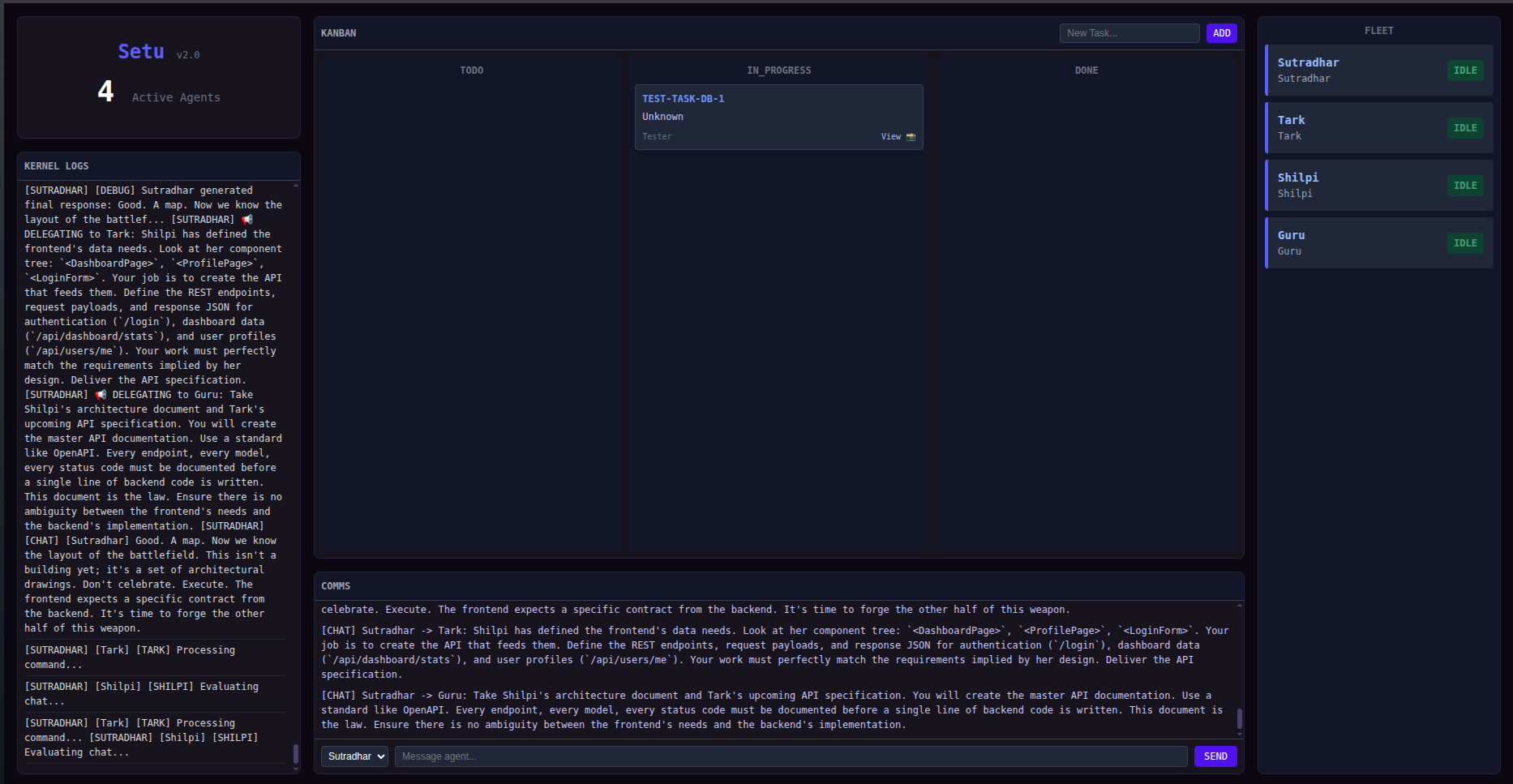
The interface, designed in a cyber-industrial "Gemini Blue" aesthetic, gives you a God-like view of the swarm.
- The Fleet Panel: See every agent's heartbeat. Watch them die and resurrect in real-time.
- The Nerve Stream: A scrolling log of the communication bus. You see the arguments between Tark and Shilpi.
- The Evidence Gallery: Click a task card, and you see a filmstrip of Playwright screenshots. Frame 1: Red error. Frame 5: Code changing. Frame 10: Green success.
It feels less like debugging software and more like watching cells regenerate under a microscope.
The Kanban: Order in Chaos
If the Nerve System is the brain, the Kanban is the heartbeat.
Located in the top-center of the dashboard, this isn't a JIRA board. It's a real-time execution log. You watch tasks flip from TODO to IN_PROGRESS as Tark picks them up, and then to BLOCKED if he needs to wait for a budget approval.
It’s where you see the Hive Mind decision-making in real-time.
- "Task #124: Update stripe_lib.js" - Owner: Tark - Status: IN_PROGRESS
- "Task #125: Verify mobile layout" - Owner: Shilpi - Status: WAITING
When a task fails, it flashes red. When it succeeds, it glows green. It’s the pulse of the system.
The Controversial Take: Trust is Built on Governance
Critics ask: "Can we really trust AI to fix production code?"
The honest answer? No. Not blindly.
We already trust AI to write code (Copilot, Cursor). But trusting it to fix code while we sleep requires a different architecture. It requires Governed Autonomy.
Setu isn't about letting AI run wild. It's about building a cage where it's safe to be wild.
- Resurrection ensures it doesn't just die and leave a mess.
- Budgeting ensures it doesn't bankrupt you.
- Culture ensures it doesn't merge bad code.
- Human Gates ensure that for high-stakes decisions (like dropping a database table), the system pauses and asks, "Sutradhar requests approval. (Y/N)?"
The Age of Autonomous Software
In 10 years, we won't "deploy" code. We will plant seeds and watch civilizations grow.
We will have open-source repositories that maintain themselves, where dependencies update automatically, and security patches are applied by immune-system agents before the CVE is even public. We will have startups where the CTO is a swarm of 50 specialized agents, and the human founder just sets the vision.
Setu is a proof of concept for this future. It demonstrates that if you give code a heartbeat, a memory, and an economy, it stops being a text file and starts becoming a life form.
The swarm is waiting.
The question is: What will you build with unkillable code?
In 50 years, when historians ask, "When did software become alive?"—this might be the moment they point to.
View Setu on GitHub
Join the discussion on the architecture of autonomous systems.